Hue Imperial City does not feel far away from modern Vietnam. That is part of what makes it land so quietly. Motorbikes still move outside, coffee shops still fill up in the morning, and then you step through the gate and the city changes shape. The space opens. The rhythm slows. The capital begins to feel older, more ceremonial, and more self-contained.
This is the core of the UNESCO-listed Complex of Hue Monuments, the former imperial center of the Nguyen Dynasty, when Hue served as Vietnam’s political, cultural, and religious capital from 1802 to 1945. UNESCO inscribed the wider complex in 1993, recognizing it as an outstanding example of an eastern feudal capital.
At a glance
| What to know | Details |
|---|---|
| Location | Inside the Hue Citadel, with the main tourist entrance at Ngo Mon Gate |
| Opening hours | 6:30 AM–5:30 PM from March 16–October 15; 7:00 AM–5:00 PM from October 16–March 15 |
| Ticket price | 200,000 VND for adults, about US$7.60 at recent mid-market rates; 40,000 VND for children aged 7–12 |
| Combo option | A 3-site combo covering Hue Imperial City plus two royal tombs is 420,000 VND, about US$15.95 |
| Time needed | Around 3–4 hours for the Imperial City alone, or a full day if you add tombs or other Hue heritage sites |
| Good for | First-time visitors, cultural travelers, photographers, and anyone building a heritage-focused day in Hue |
What makes Hue Imperial City special
Hue was planned as a defended royal capital in the early nineteenth century, with the Perfume River, Ngu Binh Mountain, geomantic principles, and formal imperial architecture all folded into the city’s design. UNESCO notes that the wider complex is remarkable not just for the monuments themselves, but for the way town planning, landscape, and royal symbolism still hold together as one setting.
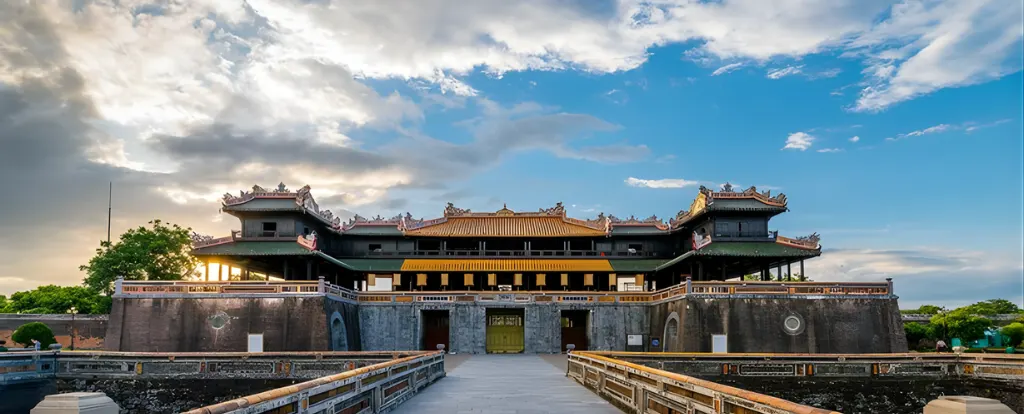
Inside that larger complex, the Imperial City is the part most visitors remember first. It was the royal administrative and residential core within the Citadel, containing the Hoang Thanh and the Forbidden Purple City. The official Hue heritage portal notes that the Imperial City is enclosed by a square wall almost 600 meters on each side, with four gates, and that the south gate, Ngo Mon, is the main ceremonial entrance.
What stays with most visitors is not only the history. It is the spacing. Moats, courtyards, tiled roofs, gateways, and long axial lines give the whole place a feeling of order that still reads clearly even after war, loss, and restoration. UNESCO notes that although some structures remain in ruins, the overall layout and many key architectural and landscape features still preserve the site’s authenticity and integrity.
How to visit without rushing the place
For most first-time visitors, the best entrance is still Ngo Mon Gate. It is the clearest arrival point, and official visitor services such as the audio guide are available there. Starting here also gives the site the right sequence. You enter through the formal southern gate, move toward the main ceremonial spaces, and let the city reveal itself in the order it was designed to do.
Morning is usually the easier time to visit. Hue’s heat can turn the stone courtyards and open spaces heavy by early afternoon, and this is a site that asks for walking rather than speed. If you only have half a day, go early, give yourself three solid hours, and keep the route simple. If you have a full day for Hue heritage, pair the Imperial City with one or two royal tombs under the combo ticket rather than trying to cram everything into the same morning.
The parts worth slowing down for
Ngo Mon Gate is more than an entrance. It sets the tone. This was the formal southern gate of the Imperial City, and it still gives the clearest sense of courtly scale at the very beginning of a visit. From there, the route naturally leads toward the central ceremonial axis.
Thai Hoa Palace matters because this was the symbolic heart of royal power. Even when visitors do not know every historical detail, the palace reads immediately as the place where order and ceremony were meant to gather. Nearby, the heritage center’s visitor materials also point to The Mieu Temple and the Nine Holy Urns, which sit to the west of Thai Hoa Palace and are among the most memorable imperial-era features within the wider palace grounds.
The Forbidden Purple City is different in mood. It was once the innermost royal residential area, and today it carries more fragility than grandeur. That contrast is part of what makes it meaningful. Hue is not a heritage site where everything survives in polished completeness. It still shows damage, absence, and repair, and that honesty is part of its weight. UNESCO explicitly notes the impact of wars and modern pressures, even as the broader complex remains sufficiently preserved to express its value.
Half day or full day
A half-day visit works well if your main goal is the Imperial City itself. That gives you enough time for the principal gates, courtyards, palace areas, and a slower circuit through the most important sections without turning the site into a checklist.
A full day makes more sense if you want to understand Hue as a heritage landscape rather than a single monument. The UNESCO property extends beyond the palace core to temples, ritual sites, pagodas, and the royal tombs arranged along the Perfume River. That is when Hue begins to feel less like one attraction and more like a whole historical atmosphere spread across the city.
Final take
Hue Imperial City is one of the heritage sites in Vietnam that still carries its original weight well. Not because everything is untouched, and not because every corner looks complete, but because the structure of the place still holds. The ceremonial axis still reads. The gates still stage your arrival. The walls still separate one kind of city from another.
FAQs
Is Hue Imperial City worth visiting?
Yes. Hue Imperial City is one of Vietnam’s most important historical sites and the centerpiece of the UNESCO-listed Complex of Hue Monuments. It is especially worth visiting if you are interested in Vietnamese history, imperial architecture, photography, or cultural heritage.
How long should I spend at Hue Imperial City?
Plan around 3–4 hours for the Imperial City itself. This gives you enough time to explore Ngo Mon Gate, Thai Hoa Palace, The Mieu Temple, the Nine Holy Urns, and the Forbidden Purple City without rushing. If you also want to visit royal tombs, set aside a full day.
What is the best time to visit Hue Imperial City?
The best time is early in the morning, shortly after opening. Temperatures are usually more comfortable, the courtyards are quieter, and you will have better conditions for walking and photography before the midday heat becomes stronger.